 In October 1939, acting on a tip that Popular Publications was starting a new pulp line, a young author and literary agent tried to convince the company to hire him to launch a pair of science-fiction pulps. Soon after, the newly hired editor sat down with publisher Harry Steeger to discuss the financial needs of the company’s brand-new science-fiction magazines.
Frederik Pohl was a month shy of his twentieth birthday when he joined Fictioneers, Inc., the name Popular gave its off-brand line of pulp magazines that paid authors and artists cut-rate prices. Armed with $600 to fill two magazines with science fiction stories, Pohl turned to The Futurians, a science-fiction fan club he helped found. It included Isaac Asimov, Cyril Kornbluth, Robert Lowndes, Donald Wollheim, and other fans who wanted to become professional science-fiction writers.
Published in alternating months, Astonishing Stories and its companion, Super Science Stories, also included cast-offs from John Campbell’s Astounding Science-Fiction, including work by Cleve Cartmill, L. Sprague DeCamp, Robert A. Heinlein, L. Ron Hubbard, Ross Rocklynne, and Clifford Simak. The magazine also featured tales from the Thursday Afternoon Luncheon Club, a group of writing professionals that included Malcolm Jameson, Henry Kuttner, and Manly Wade Wellman. Of course, Pohl himself supplemented his ten-dollar weekly paycheck from Popular by writing stories under the pseudonym James MacCreigh. He also purchased work from new writers such as Ray Bradbury and Bob Tucker, as well as Ray Cummings, the old-timer who penned “The Girl in the Golden Atom” ad infinitum.
 Astonishing Stories and Super Science Stories continued for about three years. In 1943, Popular dropped a number of its pulps, including its two Fictioneer science-fiction magazines. The paper saved was used for better-selling titles like Adventure, Argosy, Black Mask, Dime Detective, and the love and western magazines. After World War II, Super Science Stories was revived for fifteen more issues. It helped pave the way for new approaches to science-fiction storytelling in magazines such as Galaxy Science Fiction and The Magazine of Fantasy and Science Fiction.
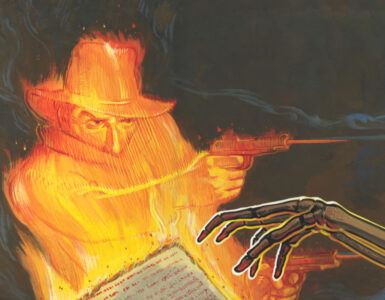
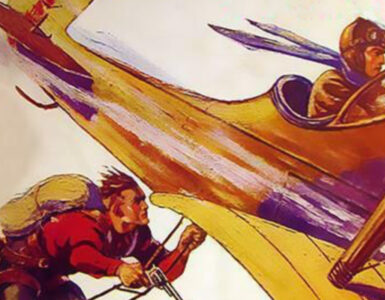
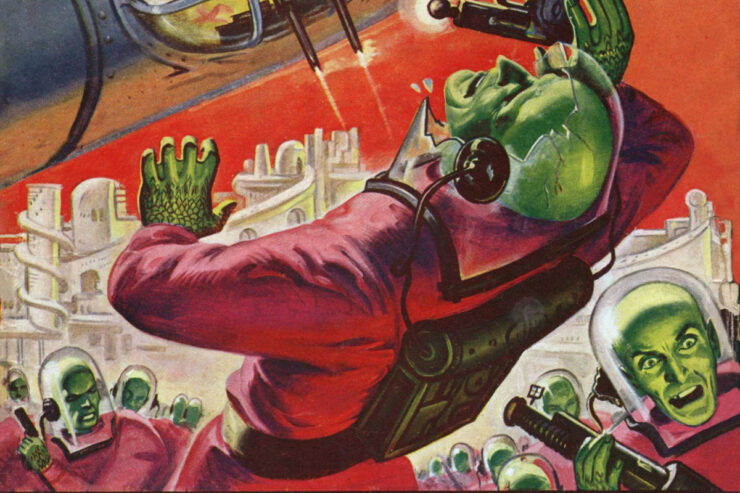
Our featured image was excerpted from Milton Luros’ front cover for the April 1943 number of Astonishing Stories, the magazine’s final issue. Our lead image is the first issue of Astonishing Stories, dated February 1940, with cover by Jack Binder. Our third image is the first issue of Super Science Stories, dated March 1940, with cover by an unknown artist.