 We honor all U.S. military veterans on November 11. The day originated as “Armistice Day” on November 11, 1919, the first anniversary of the end of World War I. The day became a national holiday in 1938 and was changed to Veterans Day in 1954.
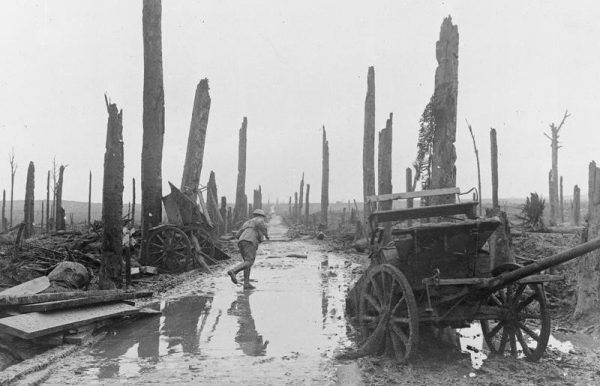
One hundred years ago today, the struggle for the battered village of Passchendaele—officially called the Third Battle of Ypres—was drawing to a close. The town’s remnants would be reclaimed by British and Canadian forces on November 6, but the fighting would last four more days.
Edwin Vaughan—an officer of the 1st/8th Warwickshire Regiment of the British Expeditionary Force—wrote about the carnage in his journal:
“Up the road we staggered, shells bursting around us. A man stopped dead in front of me, and exasperated, I cursed him and butted him with my knee. Very gently he said, “I’m blind, Sir,” and turned to show me his eyes and nose torn away by a piece of shell. “Oh, God! I’m sorry, sonny,” I said. “Keep going on the hard part,” and left him staggering back in his darkness … A tank had churned its way slowly behind Springfield and opened fire; a moment later I looked, and nothing remained of it but a crumpled heap of iron; it had been hit by a large shell. . . .
From other shell holes from the darkness on all sides came the groans and wails of wounded men; faint, long, sobbing moans of agony, and despairing shrieks. It was too horribly obvious that dozens of men with serious wounds must have crawled for safety into new shell holes, and now the water was rising about them and, powerless to move, they were slowly drowning. Horrible visions came to me with those cries, (of men) lying maimed out there trusting that their pals would find them, and now dying terribly, alone amongst the dead in the inky darkness. And we could do nothing to help them; Dunham was crying quietly beside me, and all the men were affected by the piteous cries.”
On August 25, when he awoke to take muster, Vaughan’s worst fears were realized: “Out of our happy little band of 90 men, only 15 remained.”
Such were the horrors of Passchendaele and the “War to End All Wars.” In 1914, when war was declared, street celebrations broke out across Europe. No one envisaged the trench stalemate or the appalling casualties of four years of fighting. About 8.5 million soldiers on both sides of the conflict died of wounds and disease. According to the ENCYCLOPEDIA BRITANNICA, “It has been estimated that the number of civilian deaths attributable to the war was higher than the military casualties, or around 13,000,000. These civilian deaths were largely caused by starvation, exposure, disease, military encounters, and massacres.”
Except for a single writer—Leonard Nason—stories about the First World War were very limited in the general fiction pulps. But as the rough-paper magazines began to specialize in the teens and twenties, the first pulp devoted to war tales would appear. Introduced by Dell Publishing in 1926, WAR STORIES would be followed by many others: BATTLE STORIES, DARE-DEVIL ACES, OVER THE TOP, SKY FIGHTERS, WINGS, and dozens more. Most disappeared by 1940 as another “Great War” was unfolding.
Beginning on Thursday evening, July 26, and running through Sunday, July 29, PulpFest 2018 will honor the 100th anniversary of the end of the First World War. The convention will focus on the so-called “war pulps” of the early twentieth century, as well as war’s depiction in popular culture. Please join us at the beautiful DoubleTree by Hilton Hotel Pittsburgh – Cranberry, just outside Pennsylvania’s Steel City.
We’ll also be celebrating the centennial of Grand Master of Science Fiction Philip José Farmer. PulpFest and its associated convention —FarmerCon—will salute the acclaimed author of works such as THE DARK HEART OF TIME, ESCAPE FROM LOKI, the classic Riverworld series, and more. Award-winning author Joe Lansdale will be PulpFest‘s guest of honor.
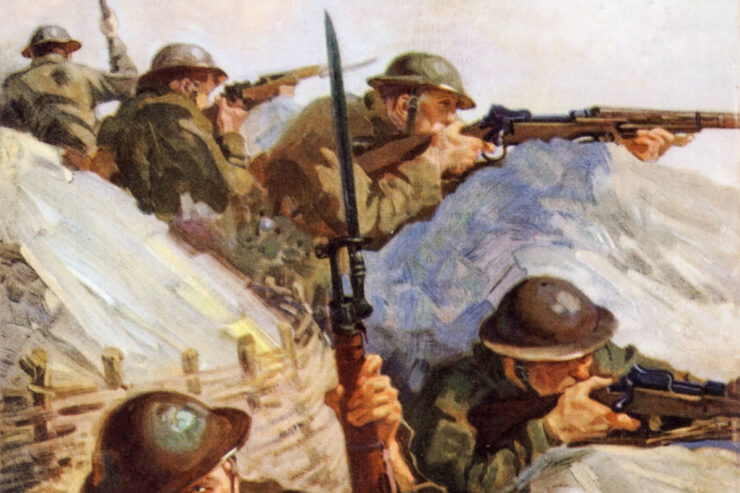
Our featured image is excerpted from Harry T. Fisk’s cover for the November 1929 issue of Over the Top, a war pulp published by Street & Smith. A student at the Art Students League in New York City, Fisk served in France with Battery A and Headquarters Company 306, Field Artillery, 77th Division. He was wounded just above the left knee by shrapnel from an exploding shell.