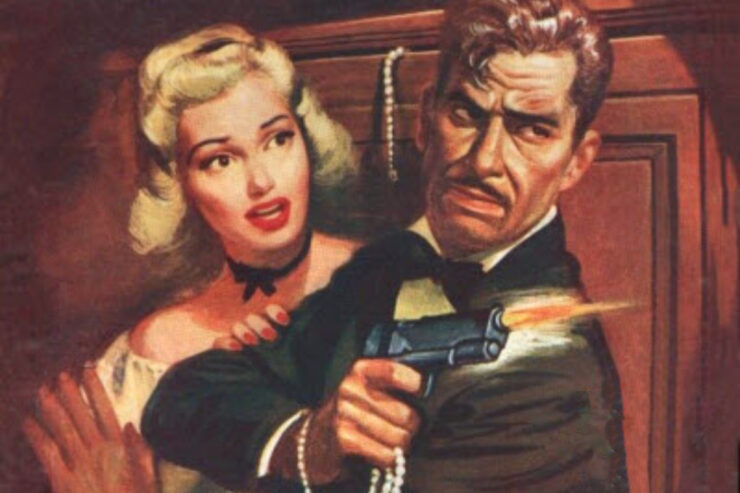
 As PulpFest wraps up another year, the convention is looking ahead. The organizing committee is already planning for PulpFest 2017. We’ll be celebrating “Hardboiled Dicks, Dangerous Dames, and a Few Psychos.” As always, expect a fantastic dealers’ room and superb programming. It will be the 46th convening of “Summer’s Great Pulp Con!” So start planning to attend. You’ll have a dangerously wonderful time!
As it looks ahead, PulpFest also looks back. One hundred years ago today, detective and thriller writer John D. MacDonald was born in Sharon, Pennsylvania, just east of the Ohio border. Best known for his detective character Travis McGee, MacDonald was one of the last giants of the detective genre to emerge from the pulps. Although his first story, “G-Robot,” ran in the July 1936 DOUBLE-ACTION GANG MAGAZINE, MacDonald would have to wait another decade for his next story to appear in a pulp magazine.
“Cash on a Coffin!” from the May 1946 DETECTIVE TALES – published by Popular Publications – marks the beginning of MacDonald’s rather substantial pulp fiction career. Over the next ten years, the author placed hundreds of stories in a wide range of pulp magazines: ADVENTURE, ARGOSY, ASTOUNDING SCIENCE FICTION, BLACK MASK, BLUE BOOK, DETECTIVE TALES, DIME DETECTIVE, DIME WESTERN, DOC SAVAGE, FBI DETECTIVE, FIFTEEN SPORTS STORIES, FIGHT STORIES, GALAXY, NEW DETECTIVE, THE SHADOW, SHOCK, SPORT FICTION, SPORTS NOVELS, STARTLING STORIES, SUPER SCIENCE STORIES, THRILLING WONDER STORIES, WEIRD TALES, and others. He also placed stories with COLLIER’S, COSMOPOLITAN, ESQUIRE, LIBERTY, McCALL’S, THIS WEEK, and other mass-market magazines.
In 1950 – as it became increasingly apparent that the pulps were on their way out – MacDonald placed a novel with Fawcett Gold Medal – THE BRASS CUPCAKE. From 1950 until he released his first Travis McGee novel in 1964, the author sold over forty paperback originals, becoming one of the giants of that market. “His crime novels of this period are masters of the form – spare, tight, often dark and even nasty tales of desperate men in way over their heads.”
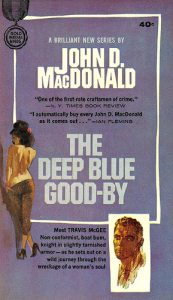 MacDonald created McGee at his publishers’ urging. Unsure of his achievement, the author resisted publication of that first novel – THE LONG BLUE GOOD-BY – until he could complete two more titles. All three books were eventually published in three successive months to positive commercial and even limited critical response.
Having achieved notoriety and success in the pulp magazines, and with more than forty novels already in print, MacDonald introduced a character that would eventually dwarf his previous publishing efforts. Travis McGee became the bedrock of MacDonald’s career, establishing a vast, devoted audience and an almost sublime literary legacy. As the epitome of this legacy, the McGee series transcends genre fiction and is rich with piercing psychological insight, social commentary, and clean, compelling prose that lapses into poetry.
John D. MacDonald wrote twenty-one novels in the McGee series, each with a color in its title. Often selling more than a million copies, the author’s Travis McGee became “one of the best, and most beloved private eyes of all time (even if he wasn’t licensed, and at times acted more like Robin Hood than Philip Marlowe).” Not bad for a pulp fictioneer!
Although centered around pulp fiction and pulp magazines, PulpFest was founded on the premise that the pulps had a profound effect on American popular culture, reverberating through a wide variety of mediums — comic books, movies, paperbacks and genre fiction, television, men’s adventure magazines, radio drama, and even video and role-playing games. The summertime destination for fans and collectors of vintage popular fiction and related materials, PulpFest honors pulp fiction and art by highlighting the many ways it has inspired writers, artists, film directors, software developers, and other creators over the decades.
We hope to see you next year at PulpFest 2017. Please bring your friends. You can expect a “Deep Blue Hello!”
John D. MacDonald was paid from half a cent to three cents per word he produced for the pulps. From about 1946 through 1951, he placed dozens of stories each year with various pulp magazines. His output included adventure, detective, fantasy, science fiction, sports fiction, and western stories. When his story “Dead to the World” garnered the cover spot for the February 1947 issue of Popular’s Dime Detective – featuring cover art by Robert Stanley – MacDonald had become a reliable producer for the pulp market.
“I don’t know how long we’re going to keep him in the pulp magazines,” Harry Widmer, the editor at Detective Fiction Weekly, said, “but we’re going to try to keep him as long as we can.”
Our lead image is the February 1947 issue of Dime Detective, with cover art by Robert Stanley. John D. MacDonald’s novella, “Dead to the World,” is the cover story.
Our featured image is Detective Tales for May 1946, featuring MacDonald’s “Cash on the Coffin!”, the story that marked the beginning of MacDonald’s rather substantial pulp fiction career. The cover artist is not known.
After The Brass Cupcake – the first of his original paperbacks – was released in 1950, MacDonald increasingly turned to that market for sales. Fawcett published his first Travis McGee novel, The Deep Blue Goodbye, in 1964, with front cover art by Ron Lesser.